I've always loved to sing. In the car, in the kitchen, pretty much anywhere nobody could hear me. For years, "take voice lessons" sat on my someday list, right next to a dozen other things I kept promising myself I'd get to.
About twelve years ago, I saw a discounted offer for voice lessons, and something in me said to just buy them. I was more nervous walking into that first lesson than I'd been in most job interviews. My teacher asked me to sing something so she could hear my voice. I sang a few lines of a song I'd heard on the radio on the drive over. She looked at me and said, "You just heard that and sang it that way? That was very nice!"
I know it sounds small. For me, it changed everything. The thing I had been afraid of for years turned out to be the best part of my week.
Since then, I've heard the same worry from a lot of people my age: "I'm too old to learn an instrument. I'd never be any good." So I went looking at the research. What I found surprised me, and I want to share it with you.
Your brain is still ready to learn
The study that stopped me in my tracks worked only with true beginners. Researchers in Geneva and Hanover followed 132 healthy retirees between 62 and 78, and to take part, none of them could have had more than six months of music lessons in their whole lives. People like the version of me who kept saying "someday."
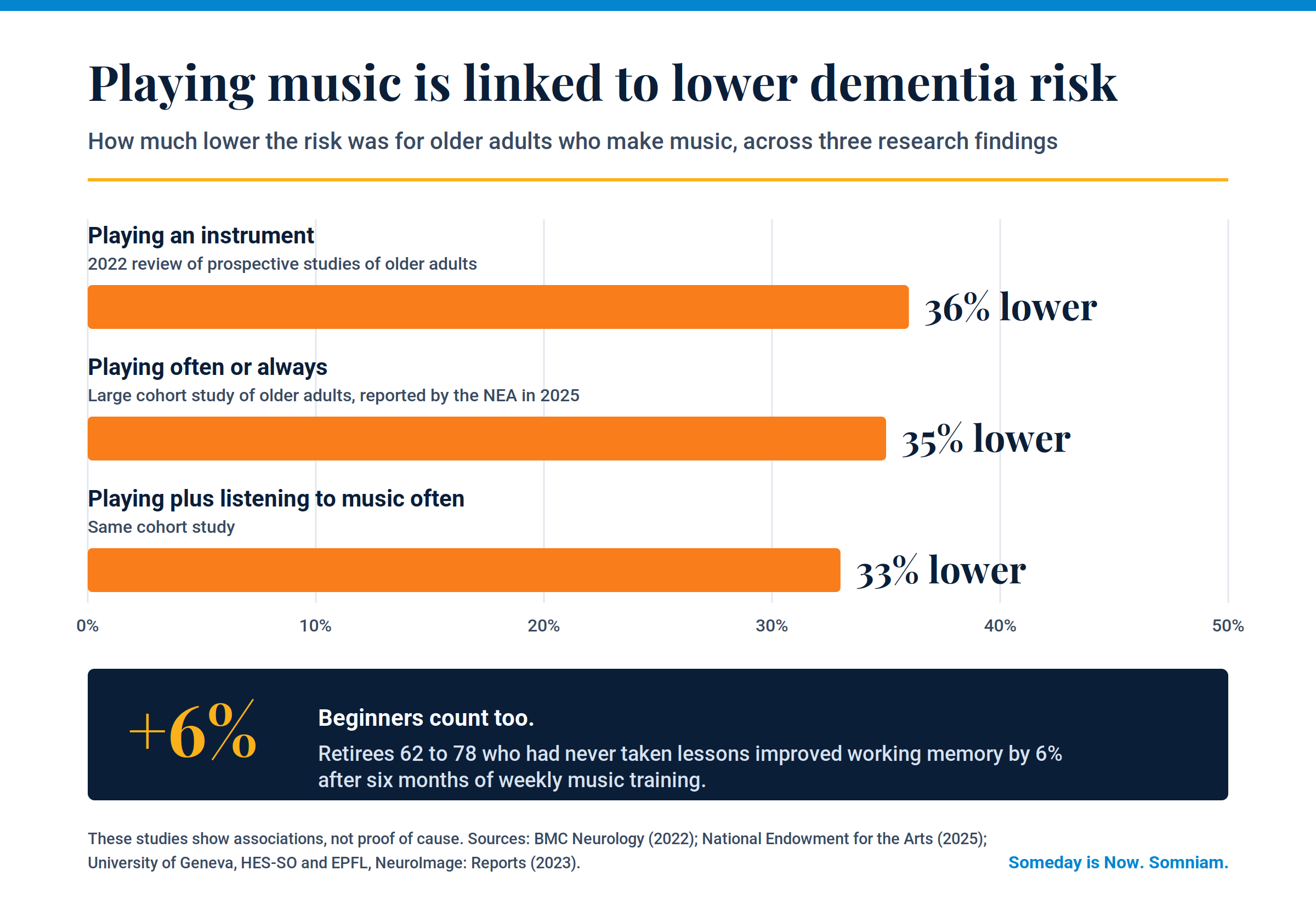
After six months of weekly lessons, brain scans showed more grey matter in four regions tied to higher-level thinking, and working memory improved by 6%. In the group learning piano, a key part of the brain that processes sound held steady, while it declined in the group that only listened to music.
At the one-year mark, the piano players had also improved their fine motor skills more than the listening group, and probably their working memory as well.
I appreciated that the researchers were honest about what this does and doesn't mean. They said music lessons don't make the brain younger. They slow aging in certain parts of it. I'll take that, especially from something I'd happily do anyway.
The bigger picture points the same way
A team at the University of Exeter studied more than a thousand adults over 40 and found that playing an instrument, especially piano, was linked to better memory and a better ability to work through complex tasks. Their lead researcher described music as a possible way to build cognitive reserve, the brain's ability to stay flexible and resilient. What moved me most was their recommendation: older adults should be encouraged to come back to music later in life.
Studies of long-term brain health line up with that. A 2022 review found that playing an instrument was significantly associated with a lower risk of dementia in older adults. A large study highlighted by the National Endowment for the Arts found that people who played often or always had a 35 percent lower dementia risk.
I want to be straight with you, because you deserve that. These studies show a connection. They don't prove that playing music causes those results. The same large study found that listening to music was linked even more strongly to some measures of cognitive wellbeing. I won't tell you a guitar will protect your memory. What I will tell you is that nothing in this research says you've missed your chance.
We have some real advantages now
When I was a kid, music lessons felt like homework. At this stage of life, they feel completely different.
Nobody is making you practice scales for a recital. You pick the music, whether it's the songs you grew up with or the album you've played a thousand times. You also know yourself much better than you did at twelve, and you know why you want to do this. And for many of us, there's finally some time. One adult band member described it perfectly: this opportunity comes at a stage of life when you actually have the time to give it, and once people join, very few quit.
You won't be the only beginner in the room
If starting alone feels like too much, you don't have to. The New Horizons music program started in 1991 at the Eastman School of Music and has grown to more than 200 bands and orchestras built for adults who want to make music together. Many welcome adults with no musical experience at all, along with people who played in school and stopped decades ago. One program's motto made me smile: "Your best is good enough!"
You'd have plenty of company. In a national poll of adults 50 to 80, 17% said they play an instrument at least a few times a year, and about 8% play with other people at least occasionally.
Your first step can be a small one
When I bought those lessons, I didn't commit to becoming a singer. I committed to showing up once. That's all a first step has to be. It could be:
- One trial lesson, in person or online
- A beginner group class, where everyone starts at the same place
- Renting an instrument before you buy one
- Sitting in on a local New Horizons rehearsal just to listen
- Fifteen minutes a day with a song you already love
If it turns out not to be your thing, that's fine. Try something else. What matters is that you didn't leave it on the list.
I built Somniam because I know how easy it is to keep saying "someday." I said it for years. So here's my gentle nudge: you don't have to be good at it. You only have to start.
Someday is Now.
Take a look at the music experiences on Somniam, or start the Pathway to see what fits you.
Sources: University of Geneva, HES-SO Geneva and EPFL, NeuroImage: Reports (2023); Worschech et al., one-year piano study (PubMed 37143214); University of Exeter PROTECT study, International Journal of Geriatric Psychiatry (2024); BMC Neurology systematic review and meta-analysis (2022); National Endowment for the Arts (Dec 2025); University of Michigan National Poll on Healthy Aging, supported by AARP (2024); New Horizons International Music Association.